Tree of Reconciliation
- Daryl Ang
- Feb 22, 2024
- 6 min read
An upcycling project that reconciles human and animal relationships and restores balance within the urban landscape.

Overview
This project tackles a given site in Toa Payoh and challenges us to discover an interesting scenario, essentially crafting a brief of our own in pairs, and then coming up with an innovative solution and design prototype as an urban response.
The solution follows the BEFI framework - Branding, Earth, Flow and Incorporation, further elaborated in the process below.

Mini Scenario
Bean Site 33 is situated within mature residential blocks in Toa Payoh Estate, of which is block 38 Lorong 5, built in 1969, a 99-year leasehold property. As such, many elderly residents populate the site and go about their leisurely activities within the communal areas. Old furniture is strewn along common areas, perhaps to repurpose them instead of discarding. These areas have been adopted by the local stray cats as their residence or gathering area as they lack a place to call home.


Site Context (Current / Proposed)
The sheltered pathways for residents are invaded by stray cats who gravitated to the furniture placed there. Consequently, there is a conflict of interest where users divert from the route to avoid the cats while some cats sustain shock and are put in danger when bicycles and electric wheelchairs zoom past them in the walkways, as observed during the site visit. We decided to locate our project site in an open area away from the pathway, under a shady rain tree, to reconcile this collision.

Branding
The prototype aims to mitigate the collision happening within the sheltered walkway by introducing a dedicated area for the stray cats to loiter and reside within. Currently, this population of stray animals are overlooked and in turn become a disruption to some residents. The location had to be within the vicinity and provide thermal comfort, but away from the formal communal areas used by residents. As such, we looked to the open field that boasted an abundance of big shady rain trees. The tree would provide both shade and structural support to the prototype.
The materials used within the structure are also upcycled from the unwanted furniture within the estate, as the intervention aims to not only be sustainable but also memorialize the history of Toa Payoh Estate in an interactive way. The mature housing that surrounds the site will no longer exist a few years down the road, thus the proposed prototype aims to leave a trace of familiarity behind.
In addition, the creation of this dedicated space enables residents to locate the felines with ease, and be able to feed them, interact with them, and even provide regular check-ups to ensure the health of the cats all in one location. This makes for easy maintenance of the area as well, instead of the current situation where cat food and drinking bowls or even temporary cardboard box housing are strewn around the neighborhood for them, polluting the cleanliness and hygiene of the neighborhood.

Earth
For the materials to construct the prototype, the town council will aid the collection of discarded furniture and objects in the area for repurposing through an upcycling process. To facilitate the design, the materials shown above were observed and documented during the site visit. As stated earlier, the use of previously owned furniture allows the site-specific memories to be memorialized in the structure and allow residents to feel connected and a sense of ownership of the space.


The main structure is made of heavy-duty PVC pipes found in HDB flats, which are sturdy and have the capability to carry some load. The hollow structure, together with simple modifications, doubles up as a cat tunnel for a private and hidden horizontal circulation the cats can use to get around.
Sisal rope, commonly used in cat furniture, is attached onto the pipes to provide grip for the cats to use as a vertical access to the upper parts of the structure for them only.
Residents are then encouraged to take part in the creation of their own additions to the structure, including platforms, cat hammocks, and basically anything else to enhance the space to foster that sense of innovation and ownership of this bottom-up approach to expansion and growth of the prototype.
The structure, being made of regular PVC pipes and connections enable it to grow indefinitely and facilitate easy replacement when it is worn-out. The prototype can be seen as a community project that transcends over generations, and as the modules wear down, they will be replaced by new “old furniture”, and the cycle repeats itself.

Above are a few speculated iterations of what a module designed by residents using the upcycled materials such as bamboo poles and timber planks may look like.
Flow
The next consideration included the dynamics and relationships between different users within the prototype. The main users would be the residents as well as the local stray cats, who are the main subject of the project. However, we also considered "intruders" such as pet dogs and how the cats would move through the prototype in such a scenario.


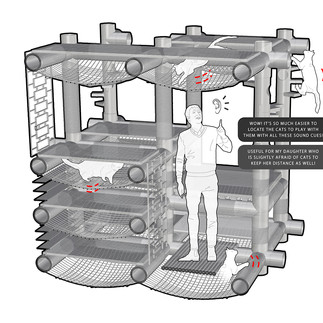


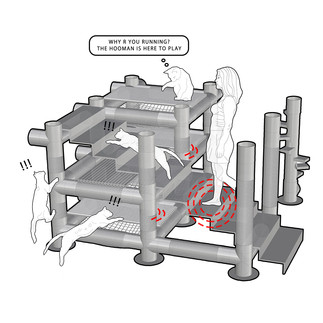
The above depicts the reconciliation between residents and stray cats within the prototype.

The structure, being one made of lightweight materials are prone to slight vibrations and ripples due to movement. As such, the cats who are extremely sensitive to movement and noises are enabled a “notification system”, enabling them to know in advance of any human approaching. They can then decide to run and hide away in the small crevices of spaces designed for them only or stay and play!

On the other hand, the structure shall also be fitted with simple devices such as bells to provide sound cues for the visitors. If you have been around cats, you would know how stealthy they can be! These sound cues will allow cat lovers to locate the felines and allow visitors who are still overcoming their fear of cats but still wish to explore the space to keep their distance.

Lastly, the prototype boasts a certain duality of space, allowing the cats and residents to co-exist harmoniously while sharing a space. Cats are rather sensitive creatures, and sometimes they just do not like to be disturbed. Low-ceiling spaces facilitate these hide-away spots and they do not need to move away even when the residents enter their space. They are also free to step out for interaction whenever they feel comfortable.

Incorporation
The prototype involves various stakeholders their roles and responsibilities are as follows:
1. Town Council – The town council facilitates the collection of unwanted furniture & objects currently strewn in communal areas within the neighborhood for upcycling, as their responsibility entails maintenance of order in the estate.
2. Residents / Contractor – The residents would then be involved in the design process of the modules made from the upcycled materials, which is then carried out by professional contractors who process these materials into the product.
3. NParks – They are consulted on the health of the selected rain tree due to its importance as the core and supporting structure of the prototype. Once the checks are complete, NParks approval enables the project to move forward.
4. Construction Team – They construct the main structural frame and insert the modules into the site.
5. Users – Residents and stray cats alike will start to gravitate toward the space, and volunteers will help to maintain cleanliness of space, feed the cats & clear the litter. Adaptations to the space will also happen as a natural process.
6. Veterinary service – Vaccinate and ensure local cats are healthy, which in turns also ensures safety of residents.
7. NEA – Clearance of rubbish and waste collected by volunteers as mentioned in Step 5.
8. Social Media – Social media platforms to reach a larger audience with our message using the prototype, allowing it to expand and be implemented within other neighborhoods as well.
9. HDB – With the demolition of en-bloc mature flats, we can liaise with HDB for new upcycling projects using the unwanted materials from the demolition, and Step 1-8 can repeat within a different site.


Participation from Residents (Visualization of Expansion)
In addition to the proposed section, we speculate the growth of the prototype by the residents themselves. They may start to impose additive elements up to their own creativity such as simple swings, seesaws, stools, potted plants and etcetera as a natural process of growth. Afterall, life finds a way. The elements depicted in red above are the additive elements of our imagination and speculation.
In conclusion, the vision is a vibrant atmosphere of activity within the proposed prototype where residents could express their creativity in upcycling without imposing on others as seen in the Mini Scenario.
- 2021 -
Group Members:
Daryl Ang
Yeoh Kai Zheng


Comments